006Legacy Modernization

Modernize the system your business cannot afford to lose.

Reduce risk, improve reliability, and move critical workflows off fragile software without betting the operation on an all-at-once rewrite.

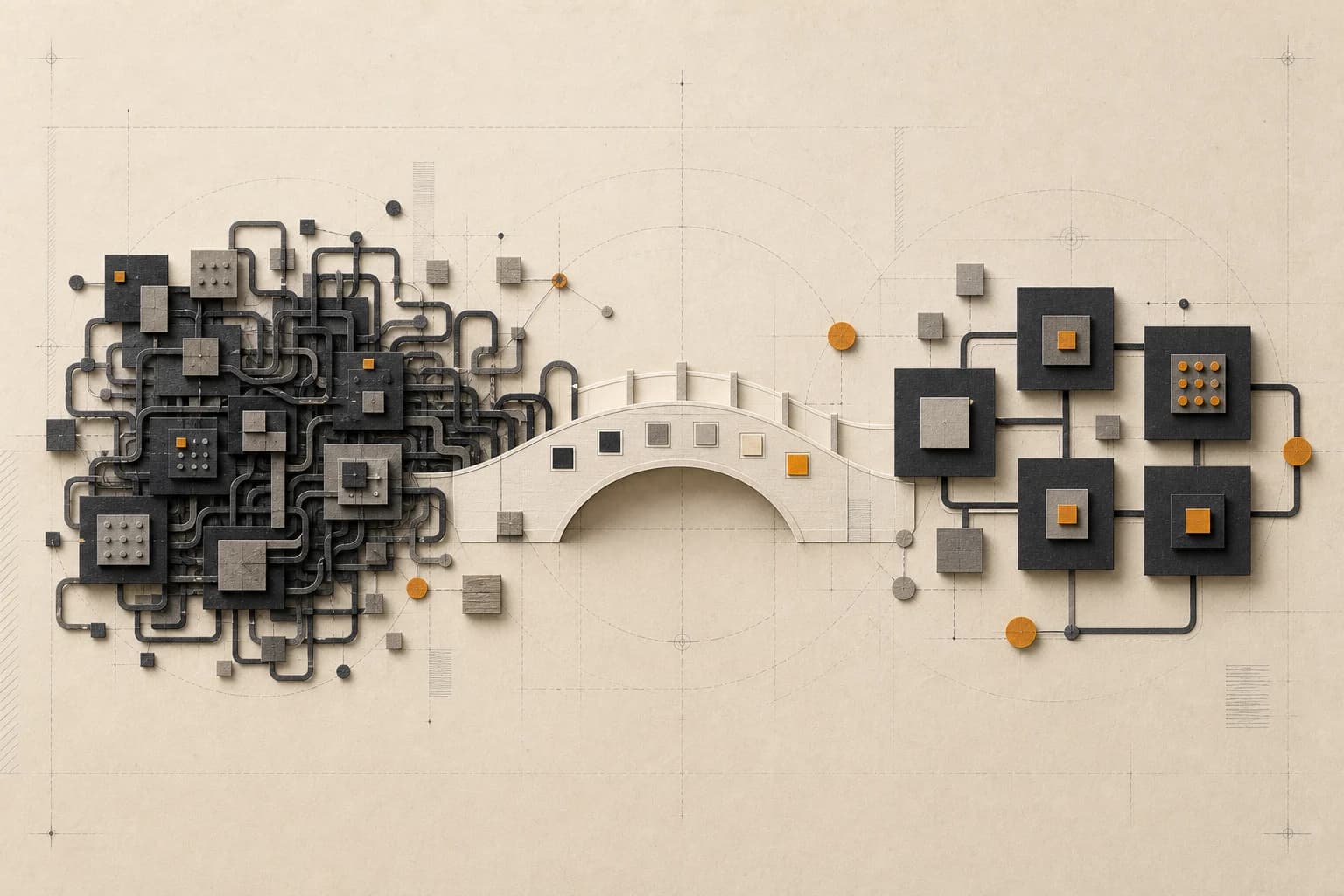
A dense fragile mechanism crossing a bridge and becoming a clean modular software system.
svc-006
migrationsrebuildsde-riskingowned by you

001What it is

Start with the business problem, not the technology.

Legacy software is not simply old software. It is a system whose risk, limitations, or cost now constrain the business: an unsupported application, a spreadsheet only one person understands, an integration that fails silently, or a platform that cannot support a required workflow. Modernization improves that position while protecting the operation the system still carries.

The right answer is rarely an automatic rewrite. A stable system with a narrow issue may need documentation, tests, monitoring, or one isolated replacement. Other systems benefit from a gradual, staged move: new capabilities are built beside the old application, data moves in controlled stages, and users switch to the new system only after its behavior is verified. A full rebuild is reserved for cases where the existing foundation cannot be made safe or adaptable economically.

Modernization succeeds when business continuity, data reconciliation, training, permissions, and rollback receive the same attention as new code. We make dependencies visible, establish a reliable baseline, and sequence changes so the team can keep operating and learning throughout the transition.
Strong fit

This is worth exploring when…

  • A critical workflow depends on one spreadsheet, desktop database, unsupported application, or employee’s undocumented knowledge.
  • Teams avoid necessary changes because deployments are dangerous, tests are absent, or nobody knows which dependent process will break.
  • The system blocks integrations, reporting, remote access, security requirements, or a new operating model the business now needs.
  • Maintenance cost and operational workarounds keep growing even though visible feature development has slowed.

A different first step

Another path may be better when…

  • The current system is stable, supported, documented, and meets foreseeable needs without disproportionate operating risk.
  • The main issue is a single defect, missing integration, or usability problem that can be isolated safely.
  • The organization cannot yet provide system access, process owners, representative data, or time for validation during migration.

002How it works

A clear path from uncertainty to a usable result.

Each stage ends in something you can review, use, and keep — never just a status update.

  1. 01

    Inventory the risk

    We map workflows, users, data, integrations, scheduled jobs, infrastructure, access, failure history, and undocumented dependencies before deciding what should change.

    deliverable: system map + risk baseline

  2. 02

    Choose the strategy

    We compare stabilization, rehosting, refactoring, incremental replacement, and rebuilding against business continuity, value, cost, and the ability to reverse course.

    deliverable: modernization + rollback plan

  3. 03

    Move in controlled stages

    We add tests and observability, build replacement slices, migrate representative data, and run parallel validation so differences are found before the old path is retired.

    deliverable: validated replacement slices

  4. 04

    Cut over with evidence

    We reconcile data, train users, execute the documented cutover, monitor production, preserve a recovery path, and retire old components only when the new operation is stable.

    deliverable: cutover + operating documentation

003What you get

Concrete outputs, written down and handed over.

output/01

System and dependency map

Workflows, users, data stores, integrations, infrastructure, scheduled work, ownership gaps, failure modes, and business-critical dates in one view.

output/02

Migration and rollback plan

A phased strategy with validation gates, reconciliation rules, cutover responsibilities, recovery paths, and explicit criteria for retiring old components.

output/03

Modern replacement capability

Tested application slices, integrations, migrated data, permissions, monitoring, and infrastructure delivered without requiring one high-risk launch event.

output/04

Operational continuity

Training, runbooks, support procedures, technical documentation, automated tests, and ownership transferred to the people responsible after cutover.

Representative scenarios / not client case studies

What this service can look like in practice.

EX-01

A spreadsheet became a system

Years of macros, copied tabs, and personal knowledge now coordinate a critical workflow. The process is mapped and moved into a controlled multi-user application in stages.

EX-02

The application stack is unsupported

A working product relies on obsolete dependencies and risky deployments. Tests and observability create a baseline before components are replaced behind stable boundaries.

EX-03

One integration limits growth

A brittle connection forces manual reconciliation and prevents new partners or channels. The integration is isolated, redesigned, and validated without rebuilding unrelated software.

004Common questions

The practical questions, answered plainly.

Related services

Have a problem that sounds like this?
Let’s map the next move.

Tell us what is happening today and what a better version would change. We’ll reply with an honest next step — even when that step is not a build.