003Automation & AI

Automate repetitive work without losing control.

Connect systems, streamline workflows, and add practical AI where it saves time — with human review, security, and dependable fallbacks built in.

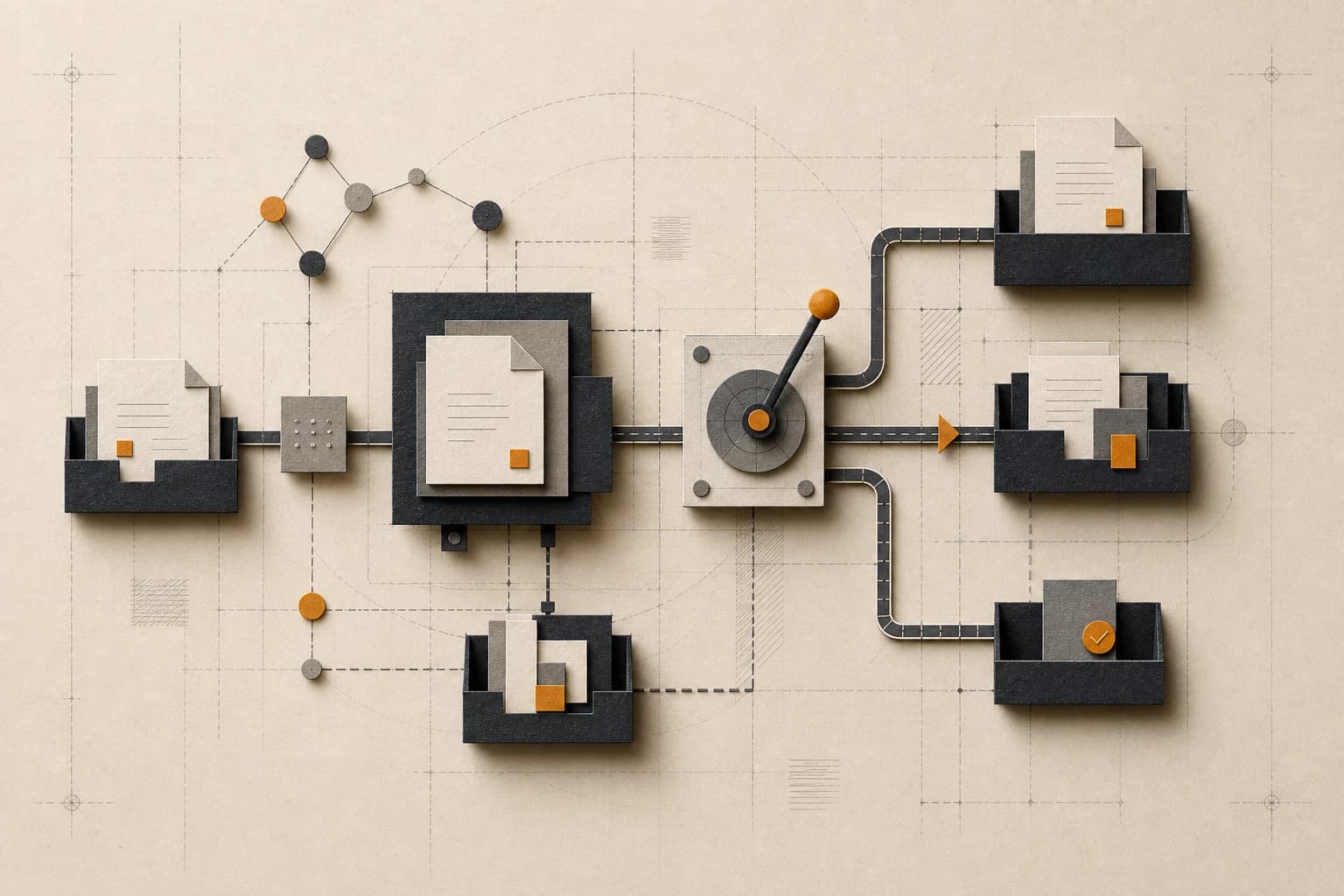
Documents and data nodes moving through an automated workflow with a visible human approval gate.
svc-003
integrationsAI featuresworkflowsowned by you

001What it is

Start with the business problem, not the technology.

Automation moves information or triggers actions according to known rules. AI is useful when the input is less structured — for example, extracting meaning from a document, classifying a request, summarizing a history, or drafting a response. Reliable systems often combine both: deterministic rules control the workflow while AI handles a narrow judgment task inside explicit boundaries.

We begin with the work rather than the model. A process that is unclear, inconsistent, or rarely repeated is usually a poor automation candidate. We look for stable, high-volume steps where people retype data, chase status, assemble the same document, or make a predictable first-pass decision. The value should be observable in saved effort, shorter turnaround, fewer errors, or better service.

Production AI needs more than a prompt. Sensitive data must be handled deliberately, outputs need validation, failures need a safe path, and people need to know when they are reviewing machine-generated work. We design those controls with the workflow, then monitor quality after launch instead of assuming a prototype will behave perfectly forever.
Strong fit

This is worth exploring when…

  • People repeatedly transfer the same information between forms, inboxes, spreadsheets, CRMs, accounting tools, or line-of-business systems.
  • A high volume of documents or messages must be classified, summarized, checked, or routed before a person can act.
  • Turnaround depends on assembling known data into quotes, reports, updates, or responses that follow a consistent structure.
  • The business can define what a correct result looks like and provide representative examples for testing.

A different first step

Another path may be better when…

  • The process is not understood, has no clear owner, or changes so frequently that automation would preserve confusion rather than remove it.
  • The decision has serious consequences and there is no practical way for a person or rule-based check to validate the AI output.
  • The task occurs too rarely to justify the cost of integration, monitoring, and ongoing maintenance.

002How it works

A clear path from uncertainty to a usable result.

Each stage ends in something you can review, use, and keep — never just a status update.

  1. 01

    Map the repetition

    We trace the current workflow, volumes, exceptions, systems, data sensitivity, and time spent. The first output is a shortlist of opportunities, not an assumption that every step should disappear.

    deliverable: opportunity + risk map

  2. 02

    Choose the right tool

    We separate reliable rules and integrations from tasks that benefit from AI, then define quality thresholds, human checkpoints, fallbacks, and a measurable success signal.

    deliverable: solution design + guardrails

  3. 03

    Prove it safely

    We test representative examples, difficult edge cases, and failure behavior in a contained workflow. Reviewers can compare the proposed result with the original process before production access is granted.

    deliverable: working proof + evaluation

  4. 04

    Integrate and observe

    We connect production systems, add permissions and monitoring, document manual recovery, and review real performance so rules, prompts, or thresholds can improve responsibly.

    deliverable: production workflow + monitoring

003What you get

Concrete outputs, written down and handed over.

output/01

Automation opportunity map

A ranked view of candidate workflows, expected value, data requirements, exceptions, risks, and where a simpler process change may be enough.

output/02

Tested proof of concept

A narrow working workflow evaluated against representative examples, including low-confidence and failure cases rather than only ideal inputs.

output/03

Production integrations

Secure connections, permissions, queues, retries, human review screens, and reliable state changes across the tools already in use.

output/04

Controls and operating guide

Quality monitoring, audit information, fallbacks, recovery steps, documentation, and clear ownership for reviewing and improving the workflow.

Representative scenarios / not client case studies

What this service can look like in practice.

EX-01

Intake reaches the right system

Requests from forms and email are validated, enriched, assigned, and written to the CRM while uncertain or incomplete submissions go to a review queue.

EX-02

Documents become usable data

Invoices, applications, or reports are classified and extracted into structured fields, checked against business rules, and presented for approval before posting.

EX-03

Support starts with context

New requests are categorized, matched with account history, and given a draft response while a person remains responsible for sensitive or unusual cases.

004Common questions

The practical questions, answered plainly.

Related services

Have a problem that sounds like this?
Let’s map the next move.

Tell us what is happening today and what a better version would change. We’ll reply with an honest next step — even when that step is not a build.